
Massage at home in Cannes: how a session works at your place, your hotel or your villa
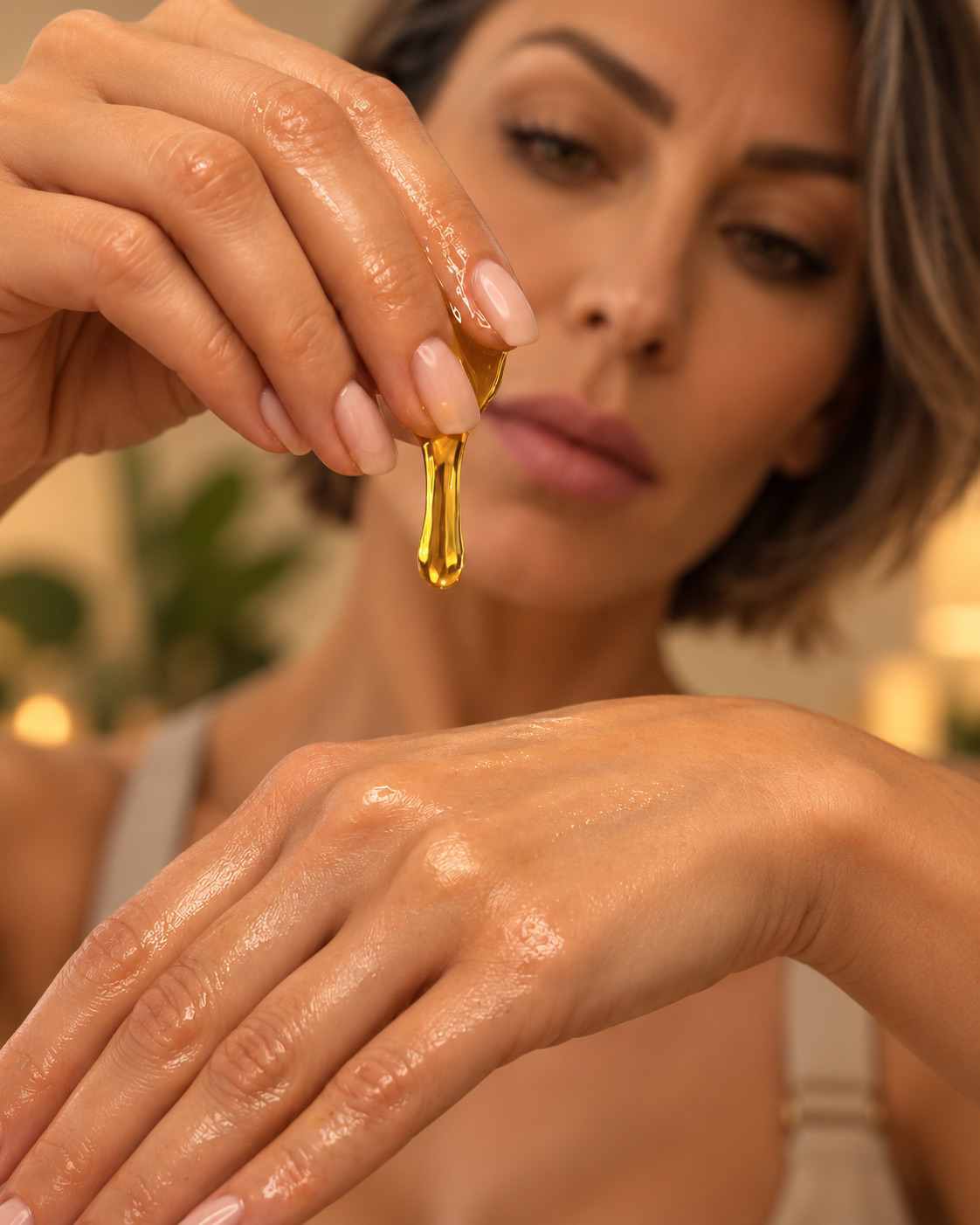
You are looking for a massage at home in Cannes and wondering what it actually involves: what I carry, how much room is needed, whether the result matches a session at the studio, and what waits for you at the door. I will answer point by point, with what works well and what works less well, because a home visit is not the right format for everyone, and I would rather you knew that before booking than after.
What I bring, and what you do not have to provide
I arrive with a professional folding massage table, the linen (sheets, towels, blanket), the oils, and everything the session needs. You provide nothing except space and warmth. The table is about two metres by seventy five centimetres, and I need to move all the way around it, which calls for an area of roughly three metres by two. A living room, a normal sized hotel room, a sheltered terrace, a pool house, a room in a villa: all of these work. A corridor or a cluttered bedroom does not.
I never work on a bed. A mattress sinks, your pelvis tips, my support disappears, and a pressure that would be right on a table becomes imprecise and sometimes unpleasant on soft bedding. If you do not have room for the table, I tell you in advance and we find another solution, or we choose a session at the studio.
The session lasts an hour and a half at the very least. That is a deliberate choice. Between setting up, the time your body takes to let go in a place it already knows, and the work itself, a single hour is not enough to justify a visit, for you or for me. Longer formats exist, and you will find them on the booking page.
Where I travel
Cannes, La Croisette and La Californie, Le Suquet, La Croix-des-Gardes, Cannes La Bocca, and also Le Cannet, Mougins, Mandelieu-la-Napoule, Théoule-sur-Mer, Vallauris, Golfe-Juan, Antibes and Juan-les-Pins, Valbonne, Biot: this whole area, which I call Cannes and its region, is served on the same terms. Monaco and its surroundings on one side, Saint-Tropez, Sainte-Maxime, Ramatuelle and Gassin on the other, are further away and fall under a separate zone rate, shown on the rates page. I do not bill travel time by the minute. The supplement is fixed per zone, which saves you any calculation and lets me carry the journey myself.
If you are staying in a hotel on the Croisette, a residence on boulevard du Midi, a villa up in Super-Cannes or a boat at Port Canto or the Vieux-Port, the principle stays the same. I have written a separate article on massage in a hotel room in Cannes and another on massage aboard a yacht, because each of these places has its own constraints.
How the arrival works
I come alone, in plain professional clothes, with no logo, nothing that tells a neighbour, a concierge or a receptionist the reason for my visit. You give me the exact address, the entry code, the floor or the room number, and how I should introduce myself if someone screens the entrance. I respect whatever you have arranged. If you would rather come down to meet me, tell me. If you would rather I come straight up, tell me that too.
Once there, I need ten to fifteen minutes to set up the table, adjust the height, prepare the linen and wash my hands. Meanwhile you take a shower if you wish, you lower the lights, you silence your notifications. We talk for two minutes about what you are hoping for and about what I need to know of your body that day, then I leave you to settle.
What changes compared with a session at the studio
The work, the length and the standard are identical. What changes is you. At the studio, your body first has to recognise a place, a smell, a light, before it lets go. At home it has nothing to recognise, and the letting go comes sooner. After the session you do not get back into a car, you do not look for a parking space, you do not cross Cannes on a Friday evening in July. You stay lying down, you sleep, you have dinner. For many of my regular clients it is that continuity, more than the journey avoided, that justifies the visit.
There is also an advantage people forget. The studio imposes a neutral setting, your home imposes your own. A terrace in the shade late in the afternoon, the sound of the sea at Théoule, a garden in Mougins: an outdoor session is possible, if the spot is sheltered from the wind and from view, and the feeling is nothing like a closed room.
What works less well, and who this format is not for
I owe you the other side of it too.
A home visit costs more than the same session at the studio, because it includes transporting the equipment, setting up, the journey, and holding a wider slot. If your budget is the first variable, the studio is the more sensible answer.
The environment is not under my control. A dog scratching at the door, a child home from school, a neighbour drilling a wall, a phone you have not silenced: all of that breaks into the session, and there is nothing I can do about it. At your place, the quality of the quiet depends on you.
Some techniques do not travel. Ashiatsu, which is done with the feet using bars fixed to the ceiling, stays at the studio, for a simple reason: I cannot carry a ceiling with me. Foot work on a portable table exists in another, more contained form, and I talk about it in the article on Ashiatsu. If it is specifically that pressure you are looking for, come to the studio.
Finally, a home session needs a minimum of notice. I do not answer a request for thirty minutes from now. The visit is paid in advance, the exact address is required, and slots between midnight and six follow particular conditions, set out on the booking page. If you are looking for immediate availability, platforms such as Wecasa work on that model in Cannes, with a different kind of service and a different price level. I am not in that market.
What massage can do, and what it cannot
I practise wellness massage, not a medical act. In France, the law of 26 January 2016 removed the word "massage" from the legal definition of physiotherapy, and the Cour de cassation confirmed on 29 June 2021 that only massage "intended to prevent the deterioration of functional capacity" remains an act reserved for physiotherapists, as explained by the Fédération française de massages bien-être. In practice: I do not treat a condition, I replace neither your doctor nor your physiotherapist, and if you come with a pain that worries you, I send you to them before I touch you.
What the research does show is a real effect on the state of tension. The meta-analysis by Moyer, Rounds and Hannum, published in Psychological Bulletin and available through the NCBI database, brought together 37 randomised studies. A single session reduces state anxiety, and a series of sessions reduces underlying anxiety by an amount comparable to psychotherapy. The same analysis shows that a single session does not lower cortisol, contrary to what you read almost everywhere. I would rather quote that result too: massage acts on what you feel, not on a figure in your blood.
Two people in the same place
If there are two of you, as a couple or as friends, I see you one after the other within the same window of time, with the same table and the same care. I work alone, so never at the same time. The booked time is shared between you. If you each want a full session, book the long format. The conditions for the second person are on the booking page.
What you prepare, in practice
A heated room, because a body massaged with oil cools quickly, even in summer under air conditioning. A light you can dim. Three metres by two of clear floor. A shower available beforehand, if you can. I advise you not to wash the oil off afterwards. Nothing else. If you are in a hotel, tell reception that someone will be coming up, without having to say why.
You book on the dedicated page, you write to me on WhatsApp to confirm the address and the access, and I confirm the slot. I do not take first contact by telephone, because I do not answer during a session, and because something written keeps a record of what we agreed.
Sources
Fédération française de massages bien-être (FFMBE), "Cour de cassation : l'usage du terme massage n'est pas réservé aux kinés", 30 June 2021: https://ffmbe.fr/2021/06/30/cour-de-cassation-lusage-du-terme-massage-nest-pas-reserve-aux-kines/
Moyer C. A., Rounds J., Hannum J. W., "A meta-analysis of massage therapy research", Psychological Bulletin, 2004, summary on NCBI: https://www.ncbi.nlm.nih.gov/books/NBK70586/
World Health Organization, "Stress", questions and answers: https://www.who.int/news-room/questions-and-answers/item/stress
Yachting Pages, "What to expect as a masseuse on a superyacht" (constraints of mobile work): https://www.yachting-pages.com/articles/what-to-expect-as-a-masseuse-on-a-superyacht.html
Comments